
Introduction
Most property management companies hit the same wall eventually. The software that worked fine at 20 units starts to struggle at 200. Rent rolls take longer to reconcile. Owner statements take longer to close. Rules around holding tenant deposits, once a small checkbox, start to feel like a real risk.
Usually, this isn’t the accounting team’s fault. It’s that the software wasn’t built for the size or type of portfolio it’s now running. Sometimes it’s the opposite problem — the software has far more features than the portfolio needs, which just adds cost and training time nobody asked for.
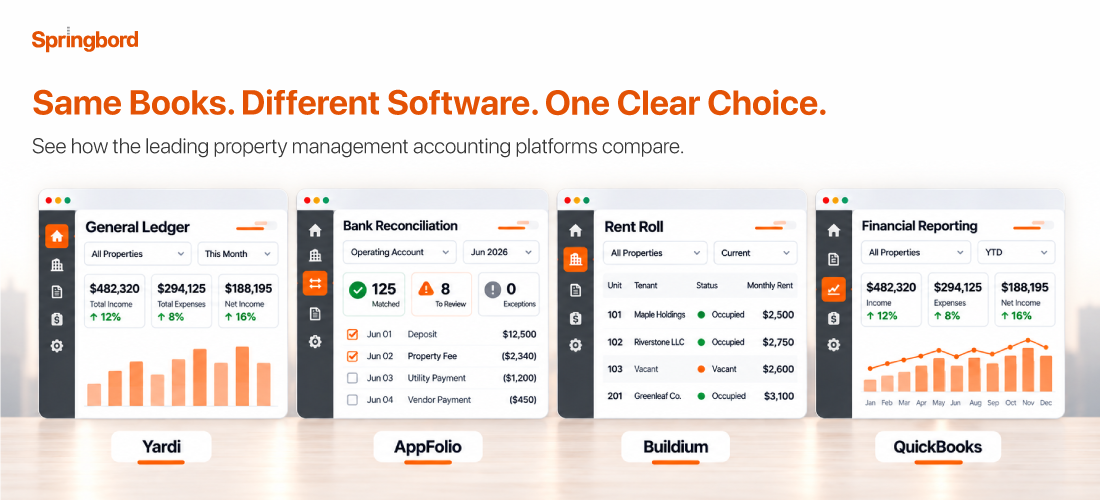
This guide compares four platforms real estate companies ask about the most: Yardi, AppFolio, Buildium, and QuickBooks. Our 6-Step Guide to Accounting for Property Managers covers what to look for in property management accounting software generally — scalability, integrations, and so on. This post goes a step further and names the actual platforms, comparing their real, published features, so you can match the software to your portfolio.
Why Software Choice Matters So Much in Real Estate Accounting
Property management accounting isn’t just regular bookkeeping with a real estate label on it. It involves holding tenant security deposits in separate trust accounts, reconciling shared expenses for commercial tenants, producing separate reports for each property owner, and handling prepaid rent and late fees correctly. General accounting software wasn’t built for any of this.
Software fragmentation makes this worse. According to the National Apartment Association’s 2025 Performance Ecosystem Report, produced with AppFolio, nearly 67% of property management professionals now juggle three or more separate software logins every day, and 60% say consolidating their tools and data into one platform would improve performance. Picking accounting software that actually fits your portfolio — instead of bolting on yet another disconnected tool — is a direct way to cut into that fragmentation.
Yardi Voyager: Built for Large, Multi-Entity Portfolios
Yardi Voyager is where most large commercial and mixed portfolios end up. Its accounting is built around handling many entities at once, so a portfolio spread across dozens of LLCs can be managed and reported on from one system, instead of piecing things together across separate tools.
For commercial real estate, Voyager’s accounting meets international reporting standards and handles general ledger entries, recurring journal entries, and CAM reconciliations directly. It also connects with tools like Microsoft Power BI for custom reporting. The trade-off is complexity: Voyager takes real time to learn, and its pricing is module-based, so the setup that actually works for a portfolio is rarely just the basic package.
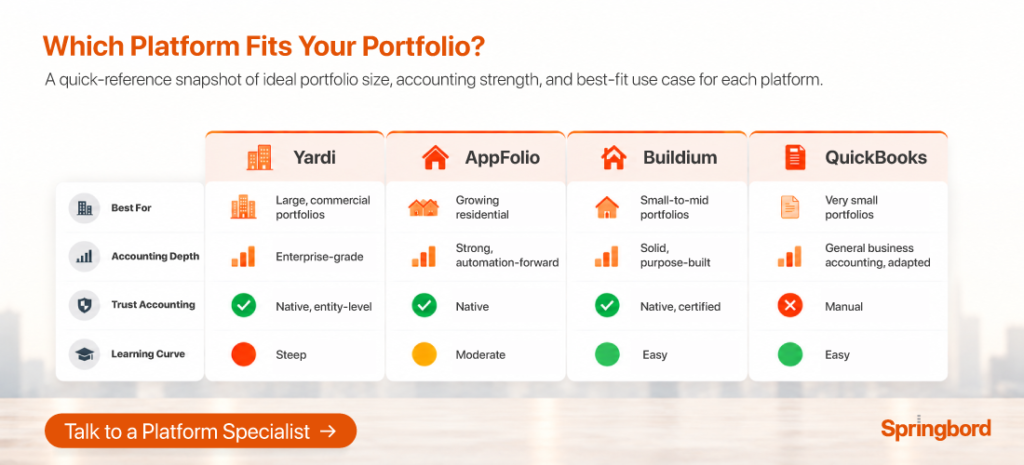
Best fit: Large commercial or mixed portfolios, spread across many entities, where consolidated reporting is a daily need — not larger residential-only portfolios.
AppFolio: Built-In Automation for Growing Residential Portfolios
AppFolio’s accounting is built around automatic bank reconciliation. It links directly to your bank accounts and matches transactions on its own, instead of requiring manual reconciliation line by line. It also handles CAM tracking, automatic late fees, and consolidated accounting for owners managing several entities.
AppFolio has also built AI directly into its software over the past few years, including an AI leasing assistant called “Lisa,” which answers renter questions around the clock, and tools like Smart Bill Entry for reading and entering invoices automatically. It’s worth being clear here: these are features AppFolio built into its own software. They aren’t something an outsourced accounting team adds — they come with the platform.
Best fit: Growing residential and mixed portfolios that want automation built into everyday accounting, without stitching together separate tools for reconciliation and leasing.
Buildium: Accessible Accounting for Smaller and Mid-Sized Portfolios
Buildium takes a different approach. It offers proper, purpose-built property accounting — general ledger, trust accounting, bank reconciliation, and 1099 filing — at a price and learning curve that suits smaller operators and HOA managers. Its plans scale from a smaller Essential tier up to a Premium tier for larger portfolios, without the long setup time that comes with bigger platforms like Yardi.
Buildium’s trust accounting is genuinely solid — solid enough that CPAs and firms managing hundreds of clients use it. But it’s best suited to portfolios in the tens to low hundreds of units, mostly residential and HOA work, rather than large, multi-entity commercial operations.
Best fit: Smaller to mid-sized residential portfolios and HOA managers who want proper trust accounting without enterprise-level cost or complexity.
QuickBooks: Flexible, But Not Built for Property Management
QuickBooks stands apart here because it isn’t property management software. It’s general small-business accounting software that operators adapt, usually by setting up properties as customers and units as sub-customers, then using Class or Location tracking to separate them. Done well, this can produce clean, tax-ready reports — often enough for a smaller operator managing a handful of properties.
The gaps show up as a portfolio grows. QuickBooks doesn’t include trust accounting or proper separation of rental funds and management fees, and there’s no built-in module for lease tracking, tenant portals, or CAM reconciliation. If you’re already comfortable using QuickBooks for the rest of your business, it can work for now — but it’s a workaround, not software built for the job.
Best fit: Very small portfolios or individual investors who need basic property-level reporting and don’t yet need trust accounting or CAM tracking.
Already Using One of These Platforms? You May Not Need to Switch
Switching your core accounting software is expensive, disruptive, and often not necessary. Most of the time, the real problem isn’t “wrong software.” It’s that the accounting team doesn’t have the time to use the software properly, or that trust accounting and reconciliation weren’t set up right in the first place.
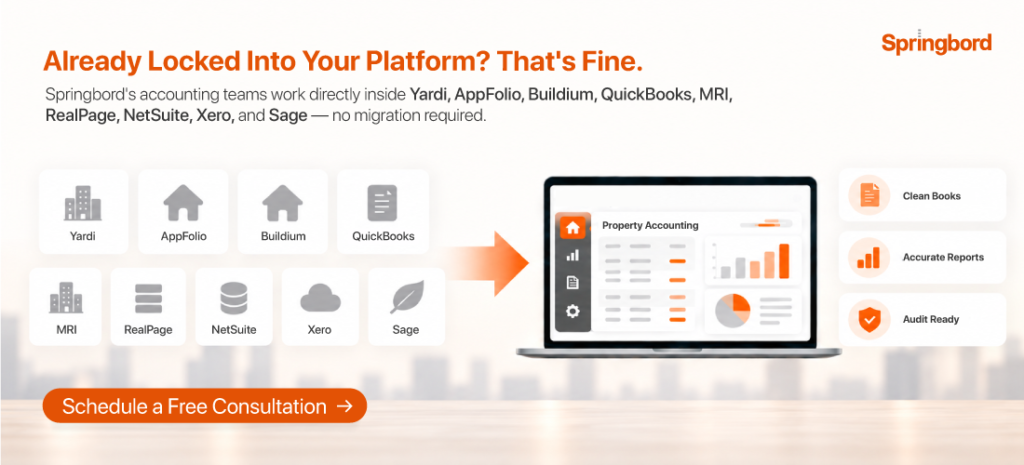
This is where outsourced accounting support helps. Instead of switching platforms, an RE accounting partner like Springbord who already knows your software can clean up your chart of accounts, tighten your reconciliation schedule, and improve reporting accuracy inside the system you already have. Our teams already work directly in Yardi, MRI, RealPage, AppFolio, NetSuite, QuickBooks, Xero, and Sage, so there’s no need to retrain your team or move your data to a new system.
Before deciding to switch software, it helps to ask one question first: is the software actually wrong for your portfolio, or is the accounting process around it not being used properly? In our experience with residential property accounting and commercial property accounting, it’s usually the second one.
A Quick Way to Decide
- Under 50 units, residential, self-managed: QuickBooks with Class tracking is usually enough, as long as your state doesn’t require strict trust accounting.
- 50–250 units, residential or mixed, growing: Buildium or AppFolio, depending on whether you want built-in automation (AppFolio) or affordable trust accounting (Buildium).
- 250+ units, spread across many entities, commercial or mixed: Yardi Voyager, as long as your team has the time to manage its setup and modules.
- Any size, if the real issue is time, not software: Look into outsourced accounting support on your current platform before assuming you need to switch.
Conclusion
There’s no single “best” property management accounting software — only the one that fits your portfolio’s size and needs. Yardi is strongest for large, multi-entity commercial portfolios. AppFolio is strongest for growing residential portfolios that want built-in automation. Buildium is strongest for smaller portfolios that need real trust accounting without a big price tag. QuickBooks works for the smallest, simplest portfolios, but hits real limits as you grow.
Whatever platform you use, how well the accounting is managed matters just as much as the software itself. If your books need attention — in Yardi, AppFolio, Buildium, QuickBooks, or any platform we support — Contact us, and we’ll walk you through what clean books could look like for your portfolio.
Frequently Asked Questions
It depends on your portfolio size. Under 50 residential units, Buildium or QuickBooks (with Class tracking) is usually enough — unless your state requires strict trust accounting, in which case Buildium’s built-in trust accounting is the safer choice. For growing residential portfolios in the 50–250 unit range, AppFolio or Buildium tend to fit best. For large, multi-entity commercial or mixed portfolios, Yardi Voyager is generally the stronger choice.
Yes, with some workarounds — setting up properties as customers, units as sub-customers, and using Class or Location tracking for property-level reports. It doesn’t include trust accounting or CAM reconciliation, so it works better for smaller, simpler portfolios than larger or commercial ones.
Not always. Many reporting and reconciliation issues stem from how accounting processes are set up within the existing platform, not the platform itself. Outsourced accounting support can often resolve this without a costly migration.
Not if the partner already has platform experience. Springbord’s teams work directly across Yardi, AppFolio, Buildium, QuickBooks, MRI, RealPage, NetSuite, Xero, and Sage.
No — Lisa, AppFolio’s AI Leasing Assistant, is a native AppFolio product feature, not something added by an outsourced accounting team. An accounting partner working inside AppFolio uses the platform’s existing automation but doesn’t build or manage it separately.